I had never given much thought to digital exhibits until this past semester, when the coronavirus pandemic led to mass-closings of museums across the globe. Due to this and my digital history course, I began to understand the importance of digital technology and online exhibits in this day and age. While all local museums have been closed since March, it was still possible to look at exhibits online. Last June, I visited the Smithsonian’s National Museum of the American Indian (NMAI) and National Museum of African American History & Culture (NMAAHC), both in Washington, D.C. By far, these museums were the most amazing historical and cultural institutions I had ever visited. I had tears in my eyes through most of my day-long tour through the NMAAHC, the exhibits were so incredibly and thoughtfully created. I listened as returning visitors guided their families through the exhibits as volunteer tour guides, taking so much pride in teaching their history to others. Because of my amazing experiences at both institutions, I decided to compare two exhibits, one from each institution. I will also note how each online exhibit component differs from its physical counterpart in the museum.
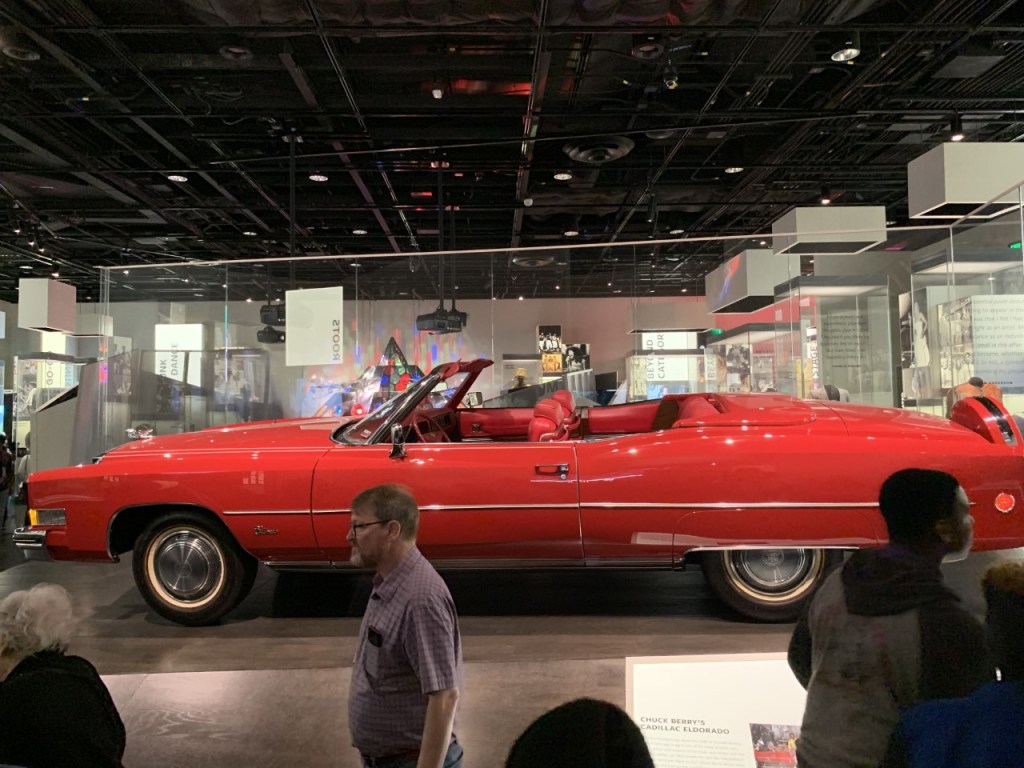
My favorite exhibit at the NMAAHC was Musical Crossroads, which is one of the most popular exhibits at the museum. Upon entering the gallery, one is immediately overwhelmed because they are standing face to face with Chuck Berry’s red Cadillac convertible, the same vehicle he drove onstage at St. Louis’ Fox Theater during filming for his 1987 documentary, Hail! Hail! Rock and Roll! What an exhibit opener! The exhibit explores the history of African American music of all genres and styles, and focuses on some of the most famous artists. I really enjoyed looking at some of Prince’s costumes, and one of his electric guitars. The exhibit website explains that “African American music provided a voice for liberty, justice and social change. In the exhibition, visitors have the opportunity to appreciate African American music as a vibrant living art form that has been a vehicle of cultural survival and creative expression. Musical Crossroads is the thread that pulls the themes of the Museum’s various galleries together in a language that is accessible to all.” The exhibit’s main messages for visitors is that African American music preserved cultural traditions, is very diverse, plays a central role in the history of American music, and that music in general is a universally-appealing lens that helps us understand American history.
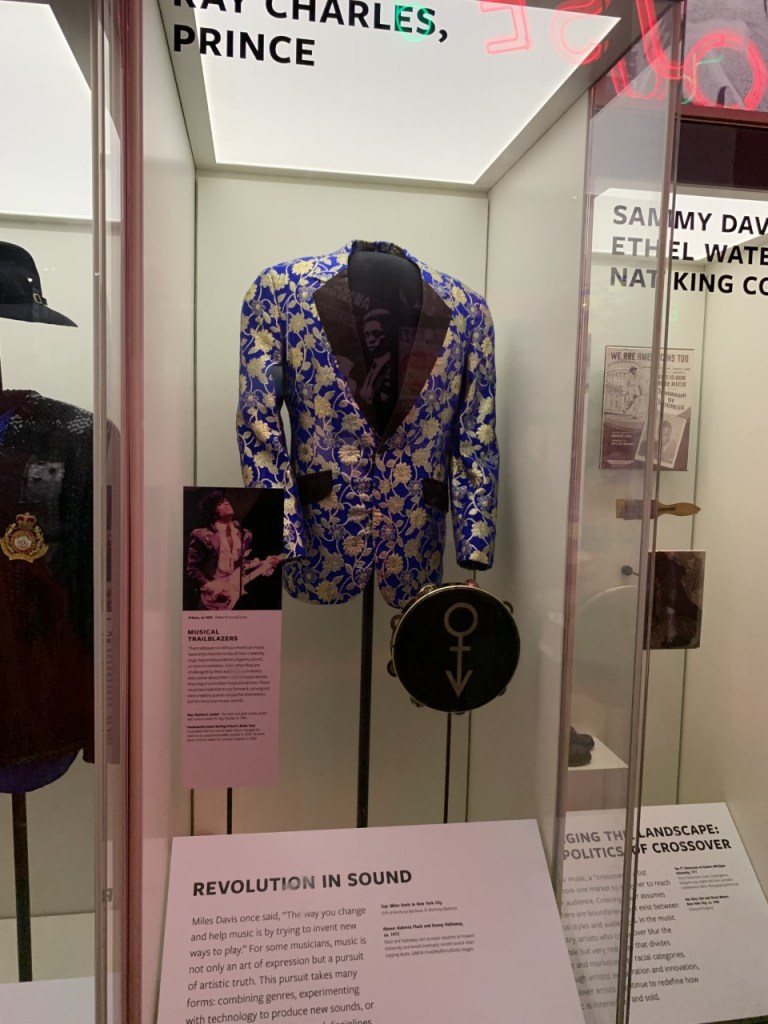
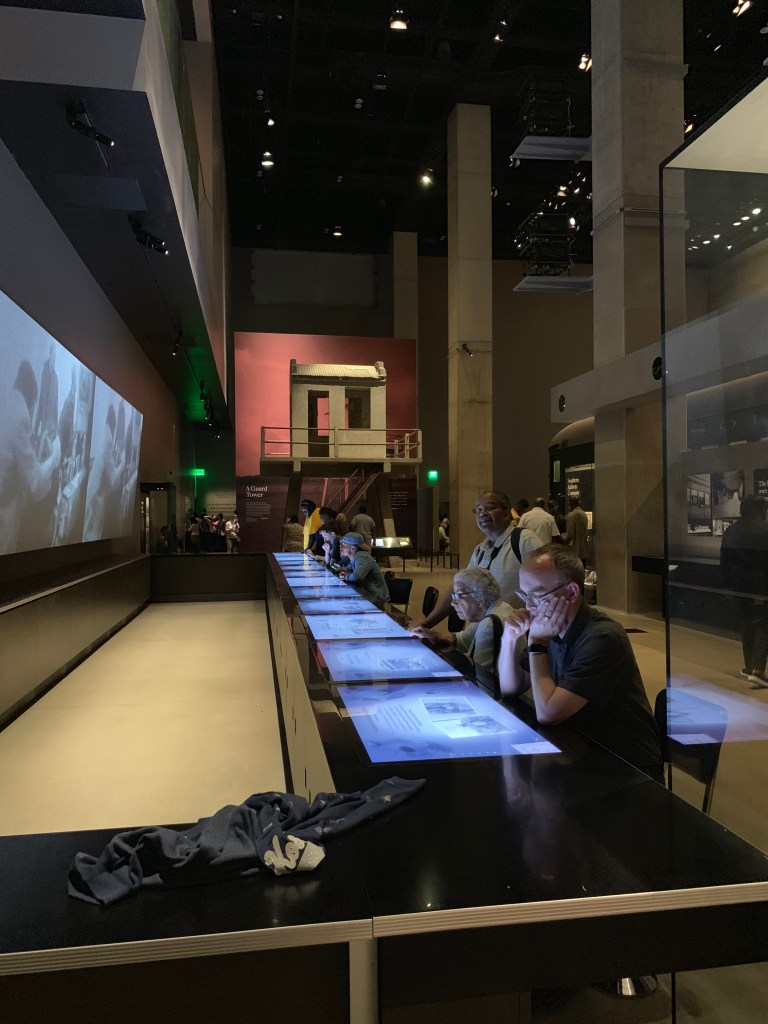
The exhibit is organized into certain themes, including Classical, Music on Stage and Screen, Rock n Roll, and Hip-Hop where objects, exhibit labels, and multimedia displays educate visitors on the artists and their music. A Neighborhood Record Store display is set up like an actual music shop and acts as a communal space for visitors to interact with each other. Museum guests can browse through mock record covers and listen to thousands of songs by accessing a large interactive touch screen table in the center of the display. Unfortunately, the exhibit website only displays images of three objects in the physical exhibit, and online visitors wishing to see other objects must search for them using the “Search the Collection” feature available through the main website’s top navigation bar. Online visitors must perform a website search in order to access features relating to the exhibit, and will be able to access blogs and information on past events pertaining to the exhibit. Ideally, all of these features should be included on the exhibit’s main page, along with links to every object displayed in the physical space, but this has not been done. There are very few photos of the physical exhibit online, which is disappointing.
Curiously, while the NMAAHC was much more detailed and impressive as a physical space, it is exactly the opposite at the NMAI: their online presence is more impressive and detailed than the physical space. While the NMAI building is quite impressive, I don’t recommend the stairs for anyone with vertigo! After almost falling a few times, I became a “frequent flyer” on the elevator. There is much empty space in the NMAI building as opposed to the NMAAHC, and I’m uncertain why so much space is not utilized at the NMAI since their collections of Native American objects are among the largest in the world. I was able to tour the NMAI in about two hours, while the NMAAHC took me seven hours.
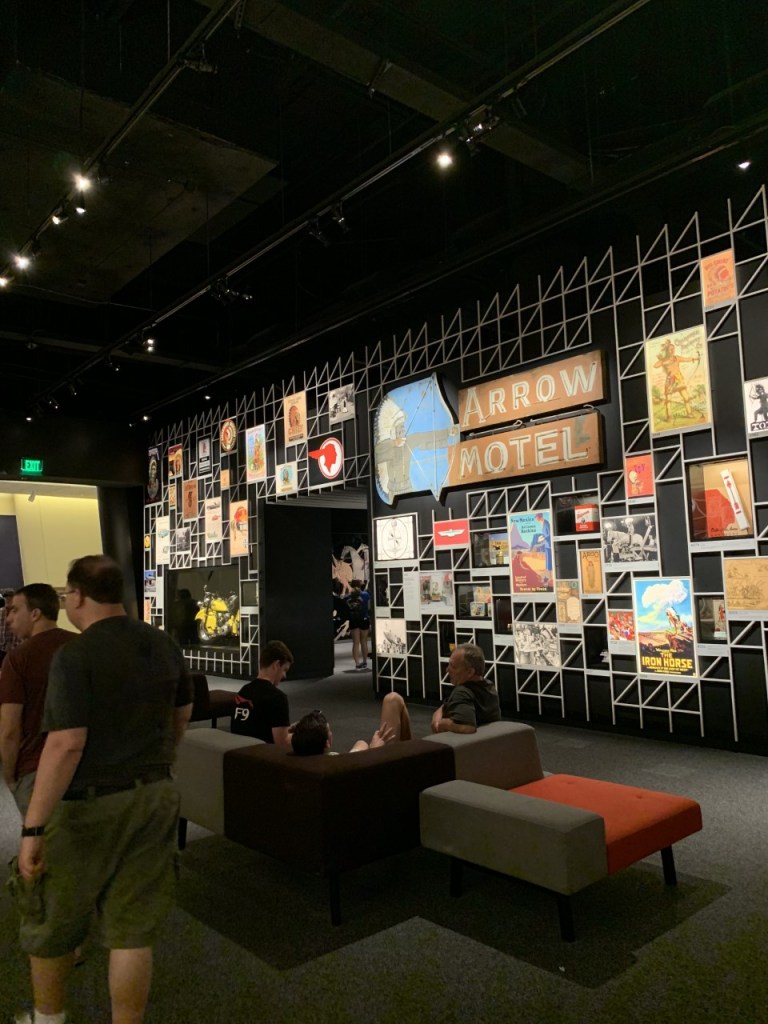
One of the largest exhibits at the NMAI, Americans, explains how images, names, and stories of American Indians infuse American history and everyday life. The exhibit discusses popular images in advertising and media like the Land O’Lakes butter maiden and the Cleveland Indians’ mascot along with characters from classic Westerns and cartoons to episodes of Seinfeld and South Park. There are detailed displays about popular people and events that most Americans likely know something about: the story of Pocahontas, Thanksgiving, the Trail of Tears, and the Battle of Little Bighorn. The physical exhibit is impressive, spanning different gallery spaces and incorporating thousands of objects into various displays. Large interactive touch screens make the experience even more interesting and engaging, as visitors can search for detailed information on each object in the exhibit. The exhibit website includes a link to a TED talk where NMAI Director Kevin Gover discusses some of the main exhibit themes.
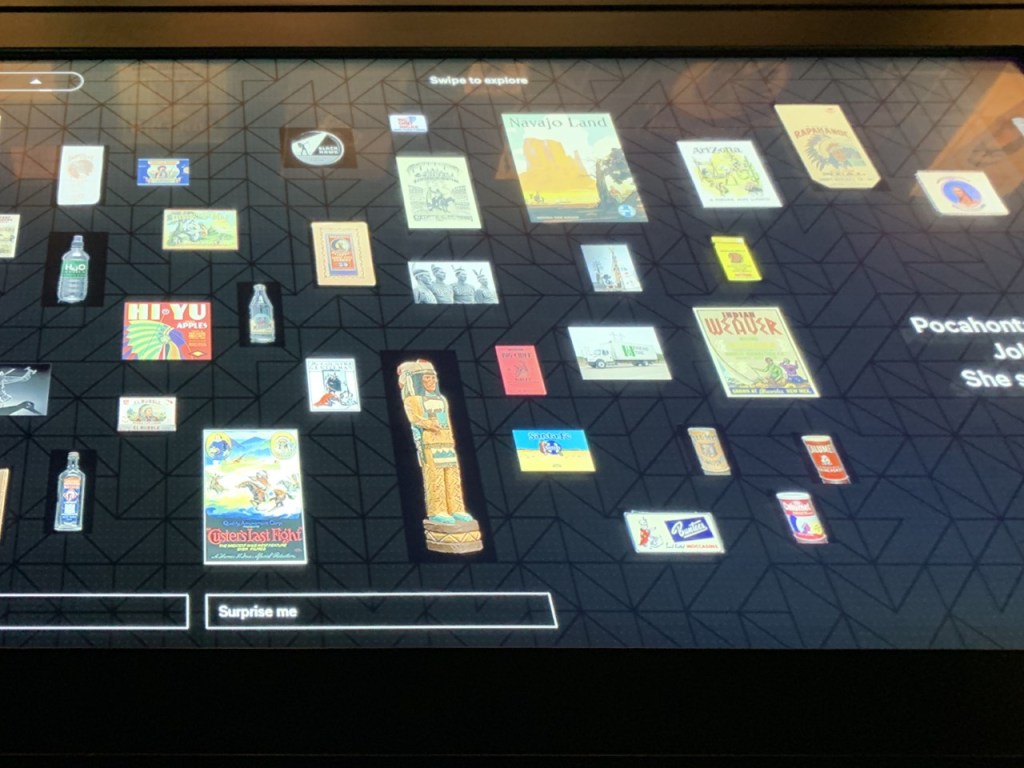
The exhibit website is interactive and very well done. Visitors can click and drag the screen on the main page to access hundreds of objects displayed in the physical exhibit. I noticed that the interactive touch screen display at the physical museum and the interactive feature on the exhibit website are almost exactly the same, which is great for those who are unable to visit the museum in person. When visitors click on an object online or select one on the museum touch screen, a larger image, description, and provenance information appears. One can easily click back out of the object detail screen back to the exhibit website’s main page or the main touch screen at the museum. Visitors can also find links to videos and detailed articles on exhibit themes as they are exploring the website’s main page. At the bottom of the page are four titles where viewers can click to access more information on main displays and themes: The Invention of Thanksgiving, Queen of America, The Removal Act, and The Indians Win. One critique is that no photos are available of the museum displays or the physical exhibit.
Comparing the physical spaces of the NMAI and the NMAAHC, both are impressive buildings with colorful, detailed, and interactive exhibits. The NMAAHC is a larger building, has ten times the exhibits, and in my opinion, is a much more fulfilling and informative experience. I was disappointed that the NMAI had so few exhibits. As for an online experience, the NMAI’s website is far superior to the NMAAHC’s website, with better-designed exhibit pages and a more detailed, interactive experience. It is easy to access photos of an exhibit’s objects at the NMAI, while one must search the collections to find them at the NMAAHC. Also, all digital features pertaining to exhibits are easily-accessed from a main page at the NMAI, while users must hunt for them through a website search at the NMAAHC. At both museums, it is unfortunate that there are few photos of the physical exhibits and museum displays, and no virtual walkthroughs, unlike other museum websites I’ve visited. As an example, The Metropolitan Museum of Art’s website has a 360° Project feature where online visitors may take a “virtual walkthrough” of select museum locations. In the future, especially in light of this pandemic and the increasing importance of virtual museum exhibits and digital content, I am hopeful that more museums will follow NMAI’s example and include thorough digital exhibits so that online visitors may experience museums in a richer way, especially if the physical locations are closed.











 Taryn's Museum Studies Blog